Monday, 12 November 2018

Honda MB8

The MB-8 is an 80cc version of the MB5 road bike produced from 1981 to 1983 specifically to meet licencing laws in France and Germany which favoured learner riders on sub 80cc bikes

By increasing the bore and stroke from 39mm x 41.4mm to 45mm x 49mm an engine size of 78cc was achieved, with power significantly improved to up to 9.5hp at 8000rpm. The MB8 shares the same 49mm stroke as the H100, making a 100cc conversion relatively simple.

Features were the same (not surprisingly!) as the MB5 with the X style frame, single disc brake on the front wheel and a rear drum brake, as well as the popular (for Honda) Comstar wheels. The tank featured a revised graphic with the addition of a stripe running parallel to the frame along the dummy covers edge.
Even though the MB8 was a Euro model, so the head light should dip to the right the headlight is actually the same as a UK MB5 (dip to the left), so this part doesn't need changing for UK roads. I guess with 6 volts the headlight doesn't do that much!
In 1983 it was replaced by the newly developed liquid cooled MBX 80.

Model: MB-8
Type: HC01
Bore and stroke: 45.0 × 49.5
Engine type: Air-cooled two-stroke single-cylinder
Engine Size: 78cc
Maximum output: 9.5hp / 8,000rpm
Maximum torque: 0.89kg-m / 7,500rpm
Gearbox: 5-speed
Frame format: X style backbone
Front Brake: Hydraulic disc
Rear Brake: Mechanical drum
Front Tyre: 2.50-18-4PR
Rear Tyre: 2.50-18-6PR
Length: 1880mm
Width: 655mm
Height: 980mm
Wheelbase: 1220mm
Vehicle Weight (kg): 91kg
Fuel tank capacity: 9L
Colours: Blue/Blue, Black/ Gold, White/Red

Red - R33 Helios Red – code 1138,
Black - NH1 Black – code 1039
White - NH24 Ceramic White - code 1005
Blue - PB109 Neptune Blue - code 1104

Two versions were available, MB8S with handlebar fairing and MB8B without.

There seems to be two European models, one for France and one for Germany. The French MB80F (F means free) is unrestricted, the German MB80SA has a few restrictions in the barrel and CDi.
It doesn't make a big difference though, 80 km/h in stead of 90 km/h for the French MB80.


Brochure


Finally 16 years old!
My bike, finally! A real. A Honda, With a two-seat saddle, 5-speed, a hydraulic disc brake, a fairing. Like the big ones!
Finally the right to practice driving with a simple motorcycle license A1. It would only be to hand over the Moto A2 license later. Or A3. Finally free to align my vitality and that of my MB 80 to show that on 2 wheels too, the value does not wait for the number of years. Neither that of cubic centimetre ...

Video


German bike to full power

A common question is how do you de-restrict a German model to full power, this is done via an un-restricted exhaust, free-flow air filter, re-jet and an ignition mod. Now the bike is full power you need to add the speed and this is done via a gearing change. See bellow for the recommended items.

1/ full power un-restricted exhaust,


2/ Generator back plate fast MB50/80, MT50/80 AC01, HC01, AD01, HD02
HP. Gives more power in combination with tuning cylinders, but also with stock cylinders!


3/ High flow air filter


4/ Bigger main jet: Jet main 12-18mm carburettor #120


5/ 38T rear sprocket to add more speed!


Links
Honda M Club on facebook

See also: Honda MB5 Honda MBX80

**** Please get in touch if you have any additional info on this model
******* Please post bellow a picture and tell us about your bike


Friday, 9 November 2018

Honda MB5

Launched in 1979 into the hotly contested sports moped market, Honda broke with their four stroke tradition with the MB50. In it’s unrestricted form this by any 50cc standards of the day was pretty quick, as was the popular trail version that was developed in parallel, the MT50. 

Honda being Honda didn't want to make just another 2-stoke bike so developed the new motor with a balancer shaft opposed to its competitors that just used rubber mounts. The Balancer shaft was a weighted and off-set rotating shaft that was geared to the crank and was designed to counter-act motor  vibrations. The MB also came with three spoke ComStar style wheels, a cockpit faring and a front disc brake which ticked all the right box's for any aspiring 16yr old riders with sporting ambitions. 

In the UK is was officially only on sale for two years (although stock and bikes would of lasted longer) and was replaced with the MBX50. In different markets it was available up to 1988 giving the bike a healthy 9 year lifespan making the spare parts availability strong, even today.

Pre-production

Interestingly early in its development the MB5 was originally called the CB-X5 as you can see from these Honda development sketches kindly shared by M Club page member Ian Foster.

Image: Ian Foster
Image Ian Foster

Image Ian Foster

UK and European model

The Honda MB5 (MB50) was produced in Europe from 1979 to 1981. They came in black, red, and white with a blue stripe. It also gained a nose fairing around the headlight and Clip-on style handlebars.

It featured a relatively unusual design in that the fuel tank stretched underneath the seat so that it could leave some room for the 2-stroke oil tank which is situated at the front of the fuel tank.
Typical for Honda the engine is a little over engineered as it features a balancer shaft to reduce vibration and this feature was retained in all of the M series engines.


Specifications (UK)

Engine: Air cooled, single cylinder, 2-stroke
Bore and Stroke: 39mm x 41.4mm
Displacement: 49cc
Compression Ratio: 5.9:1
Carburettor: Piston valve type
Starting System: Primary kick
Max. Horsepower: 2.55ps/ 6000rpm (DIN)
Transmission: 5-speed constant mesh
Clutch: Wet multi-plate
Ignition: Fully transistorised
Frame: Cross line backbone design
Suspension front: Telescopic (travel 125mm)
Suspension rear: Swing arm (travel 90mm)
Tyres front: 2.50 x 18-4 PR
Tyres rear: 2.50 x 18-6 PR
Brakes front: Disc
Brakes rear: Internal expanding shoe (drum)
Length: 1880mm
Width: 655mm
Height: 1160mm
Wheelbase: 1220mm
Seat Height: 750mm
Ground Clearance: 160mm
Fuel Capacity: 9 Litre
Curb Weight: 90kg
Colours / paint codes:
Red - R33 Helios Red – code 1138,
Black - NH1 Black – code 1039
White - NH24 Ceramic White - code 1005
Blue - PB109 Neptune Blue - code 1104

What Honda said:

"Honda's MB50 will give you all the excitement of motorcycling right from the start. Says Ron Haslam, 1979 World TT Formula 1 champion.
Exciting looks. Packed with brilliant new engineering developments. Made to give super smooth, trouble-free ride in the true Honda tradition. That's the MB50.
It's a machine that will set new standards, a machine to be proud of. what better way can there be to get the feel of two wheels!
The MB50 features a hydraulic disc brake on the front carefully balanced by a dependable drum on the read, to give sure, safe stopping power. The disc fluid reservoir is clear so you can see the level at-a-glance- you won't have to put off those vital checks until you have a spare moment!
It has 'big Honda' Comstar wheels, which combine the flexibility and strength of spoked wheels with the style of solid cast alloy wheels, and contribute in no small way to the MB0's excellent handling properties.
It has non glare speedo and tacho instruments - easy to see even in harsh lighting conditions - well positioned controls, and a low centre of gravity, all of which help make riding easier and safer.
As Ron Haslam said when he saw the machine: "This must be the ultimate road bike for the new rider - it's got so much much going for it."

The MB50. What a great way to start."


note the optional panniers


US version: MB50C

Officially only imported as an 82 model, the colours were black body and frame and a red stripe, and red body and frame with a blue stripe. This model differed to the Euro bike as it didnt have a handlebar fairing, it had higher rise conventional handle bars and had a different single style seat unit with no pillion foot pegs. Unusually the USA version ran 12v electrics (UK had 6V) and also had a high beam warning light.


Honda MB50 Bol d'Or


The Dol d'Or was a Belgium market special edition with the addition of a frame mounted half fairing, this is the original brochure text translated in to English.

"The Bol d'Or. The Honda Prestige for youth fairs, a complete range of resistance, performance, road-holding and braking power, A mono-cylinder 2-stroke engine with air cooling, equipped with a balanced crankshaft to make the whole vibration free. Disc brake voorann, wide tires (80/90 x 18), kilometre equipment speedometer, tachometer, quartz clock (as an option) and a windshield that continues the great tradition of his glorious predecessor and gives the whole a young, classy view.

The Bol d'Or is supplied by the factory in the legal moped version, but there is a kit to make it on your 18th a real engine with a remarkable performance."

Dutch MB50P (1980)

In The Netherlands the MB5 was available with a 'pedals' kit, this turned the bike in to a traditional moped meaning you can pedal the bike like a bicycle. The pedal cranks axle ran in parallel behind the swing arm axle via a unique swingarm with a secondary chain linking the pedalling sprocket to a secondary front drive sprocket. The pedals would of been disengaged for motorised running. 


European MB50 - 1984-1992

Produced in Belgium for the Dutch market the MB5 continued with some styling additions, most notably the addition of the lower frame cradle to modernise the bikes looks. The final models included the addition of MBX ComStar alloy wheels. Colours were white/ blue and white/red.
Thanks to M Club member Michael Vogels for his help on this model.


Colour options for 1984-1985 (with Comstars)
without frame cradle rails but with original type wheels


The future? 

As a foot note, Kar design re-imagined the MB5 for the modern era. Honda won't build this but it's nice to think that if they did it might look something like this. Check our Kar's facebook page here:


Brochure selection


Video


Model Kit by Tamiya:


Model/ country codes:
MB50F MB5 1980 (A) AUSTRIA
MB50F MB5 1980 (A) SWITZERLAND
MB50F MB5 1980 (A) EUROPEAN DIRECT SALE
MB50F MB5 1984 (E) EUROPEAN DIRECT SALES
MB50F MB5 1984 (E) SOUTH AFRICA
MB50PA MB5 1979 (Z) NETHERLANDS
MB50S MB5 1980 (A) BELGIUM
MB50S MB5 1980 (A) ENGLAND
MB50S MB5 1980 (A) GERMANY
MB50S MB5 1980 (A) NORWAY
MB50S MB5 1980 (A) SWEDEN
MB50 MB5 1982 (C) USA
MB50 MB5 1979 (Z) JAPANESE HOME MARKET
MB50P 1980 (A) NETHERLANDS
MB50P 1981 (B) NETHERLANDS
MB50P 1982 (C) SOUTH AMERICA
MB50P 1984 (E) NETHERLANDS, SOUTH AMERICA
MB50S2 1982 (C) SWITZERLAND
MB50S 1980 (A) BELGIUM
MB50S 1981 (B) BELGIUM
MB50S 1982 (C) SWITZERLAND
MB50S 1984 (E) NORWAY
MB50S 1985 (F) NETHERLANDS
MB50S 1986 (G) NETHERLANDS
MB50S 1987 (H) BELGIUM

For more info on this model please also check out:

UK MB5 site http://www.mb5.co.uk/index.html
USA MB5 site http://www.hondamb5.com/info

Facebook groups

Honda M Club (UK)
Honda MB/MT Bikes
Honda MB5 owners

See also: Honda MB8

**** Please get in touch if you have any additional info on this model
******* Please post bellow a picture and tell us about your bike 

Tuesday, 6 November 2018

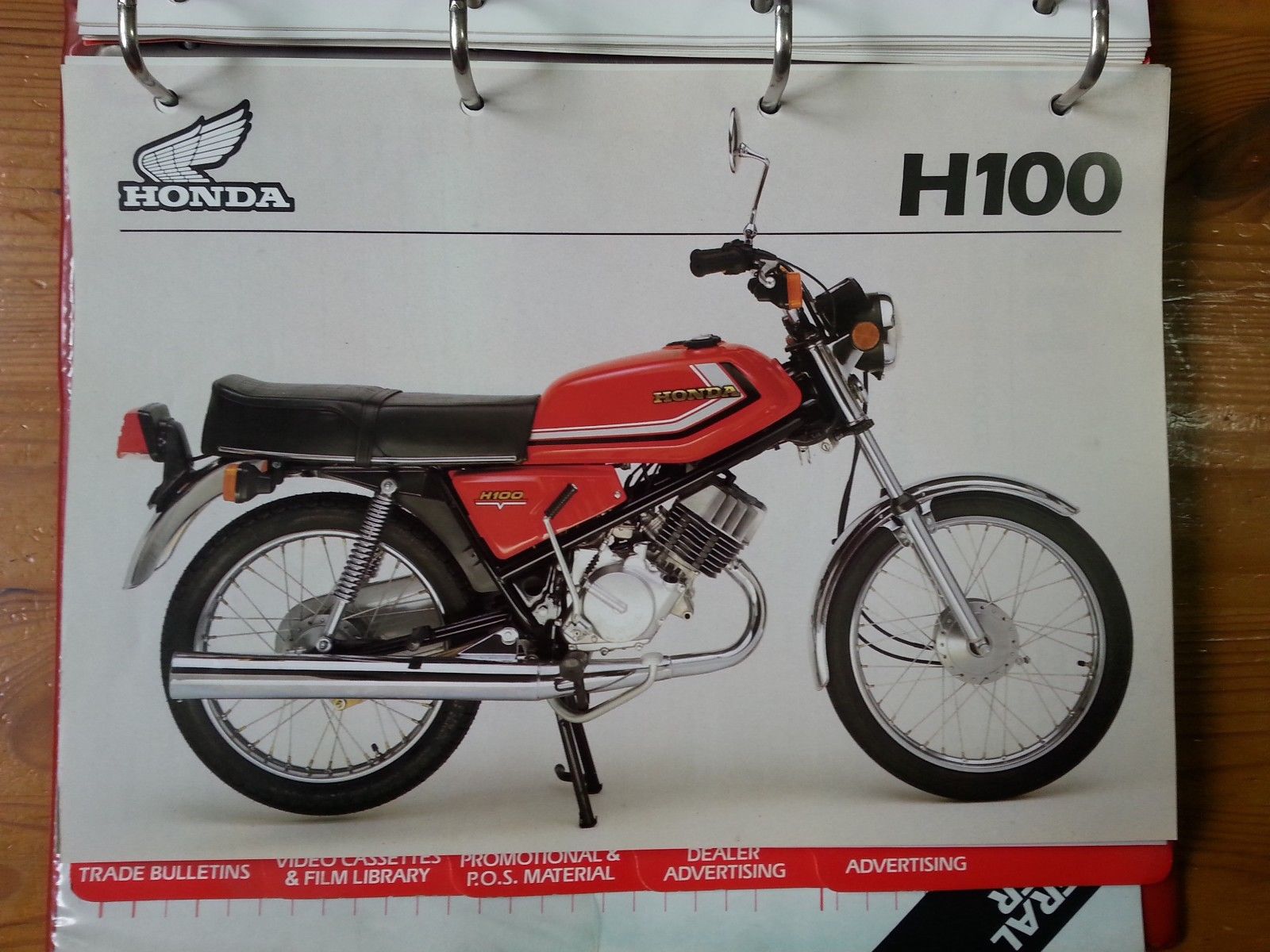
Honda H100 / MB100

The Honda H100S is a two-stroke motorcycle introduced in June 1983, alongside the original Honda H100-A, which was released to the UK in February 1980. The H100-A was built for fulfilling the role of an economical, practical, lightweight commuter machine. It was designed for riders who preferred the simplicity of the two-stroke engine. In Honda style, equipment such as a fully enclosed chain, capacitor discharge electronic ignition (CDI), and a separate oil injection system allowed easy operation of the motorcycle with the minimum of maintenance and attention. The lowly-tuned engine gives adequate performance for use in normal traffic conditions, but does not consume high amounts of fuel. Under normal operating conditions, mileage to the gallon figures regularly exceed 80, often close to 100, impressive for a two-stroke and not far off Honda's own four-stroke commuting machines.The engine uses a reed-valve induction system, and the vibration inherent in single cylinder engines is largely cancelled out by the single shaft primary balancer.

The H100-S was introduced alongside the H100-A which continued in production until stocks were exhausted. The H100-S is a heavily revised version of the original, losing some of its more practical features as a result. This was felt necessary to give it a wider appeal. The oil tank was moved from being part of the fuel tank to behind the right hand side panel, the final drive chain casing was relieved for a sleeker, chrome plated top cover, the clocks were made separate from the headlight to allow for a new tachometer, and, strangely, the CDI ignition system was replaced by a contact breaker system (points).

March 1986 saw a largely cosmetic reworking of the H100-S, to form the H100-SII. This model received bolted-on frame down tubes which gave the appearance of a conventional cradle-frame motorcycle. The ignition system was reverted to CDI, and all other changes were in terms of paint and graphics.

Production of the H100-SII ended in 1992.

MB100


H100 S2
Many H100's were used as engine donors as a cheap performance upgrade for MB5's!